“There remains, then, a Sabbath-rest for the people of Elohim; for anyone who enters Elohim’s rest also rests from their works, just as Elohim did from his.” – Hebrews 4:9-10
1) Adam and Eve, and Elohim were present for the very first 7th Day Sabbath.
Genesis 1:26 – 2:3
26 And Elohim said, Let us make man in our image, after our likeness: and let them have dominion over the fish of the sea, and over the fowl of the air, and over the cattle, and over all the earth, and over every creeping thing that creepeth upon the earth.
27 So Elohim created man in his own image, in the image of Elohim created he him; male and female created he them.
28 And Elohim blessed them, and Elohim said unto them, Be fruitful, and multiply, and replenish the earth, and subdue it: and have dominion over the fish of the sea, and over the fowl of the air, and over every living thing that moveth upon the earth.
29 And Elohim said, Behold, I have given you every herb bearing seed, which is upon the face of all the earth, and every tree, in the which is the fruit of a tree yielding seed; to you it shall be for meat.
30 And to every beast of the earth, and to every fowl of the air, and to every thing that creepeth upon the earth, wherein there is life, I have given every green herb for meat: and it was so.
31 And Elohim saw everything that he had made, and behold, it was very good. And the evening and the morning were the sixth day.
2 Thus the heavens and the earth were finished, and all the host of them.
2 And on the 7th day Elohim ended his work which he had made; and he rested on the seventh day from all his work which he had made.
3 And Elohim blessed the 7th day, and sanctified it: because that in it he had rested from all his work which Elohim created and made.
2) Abraham kept the 7th Day Sabbath 430 years before the Israelites received the 10 Commandments at Mt. Sinai.
Genesis 26
5 Because Abraham obeyed my voice, and kept my charge, my COMMANDMENTS, my statutes, and my laws.
Genesis 12
40 Now the sojourning of the children of Israel, who dwelt in Egypt, was 430 years.
41 And it came to pass at the end of the 430 years, even the selfsame day it came to pass, that all the hosts of Yahweh went out from the land of Egypt.
3) Both the Israelites and Gentiles received the 10 Commandments, which include the 4th Commandment to REMEMBER the 7th Day Sabbath at Mt. Sinai. To remember something implies that it was forgotten. Therefore, the Israelites were already keeping it just like their father Abraham, but had forgotten it due to their sojourn in Egypt. Elohim also teaches that His laws are for both the native Israelites and the strangers or Gentiles dwelling with Israel.
Exodus 12
37 And the children of Israel journeyed from Rameses to Succoth, about six hundred thousand on foot that were men, beside children.
38 And a MIXED MULTITUDE went up also with them; and flocks, and herds, even very much cattle.
49 One law shall be to him that is homeborn, and unto the stranger that sojourneth among you.
Exodus 20
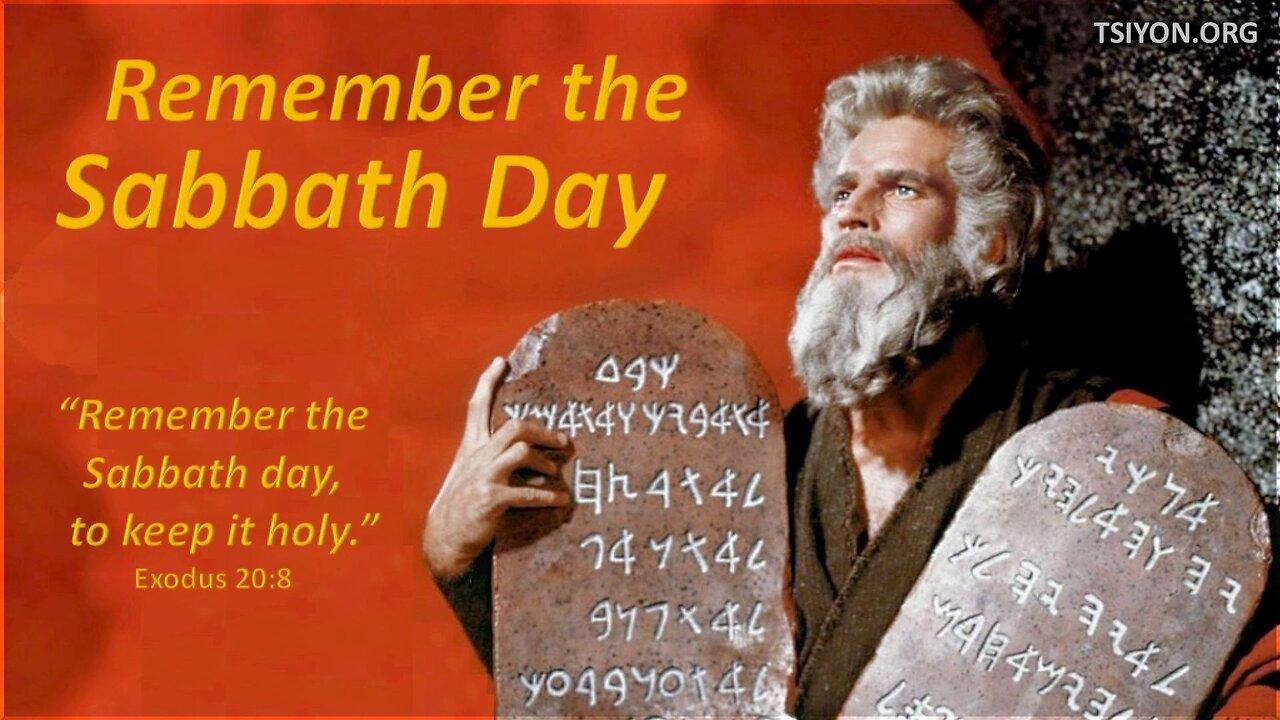
8 REMEMBER the sabbath day, to keep it holy.
9 Six days shalt thou labour, and do all thy work:
10 But the 7th day is the sabbath of the Lord thy God: in it thou shalt not do any work, thou, nor thy son, nor thy daughter, thy manservant, nor thy maidservant, nor thy cattle, nor thy STRANGER (GENTILE) that is within thy gates:
11 For in six days the Lord made heaven and earth, the sea, and all that in them is, and rested the 7th day: wherefore the Lord blessed the sabbath day, and hallowed it.
4) Philo Judaeus, also called Philo of Alexandria, lived from approximately 15 BC to 50 AD. He came from a very prominent family; his historical writings are considered extremely valuable. He reports to us that the whole world observed the 7th day Sabbath, not just the Jews.
“But after the whole world had been completed according to the perfect nature of the number six, the Father hallowed the day following, the seventh, praising it and calling it holy. For that day is the festival, not of one city or one country, but of all the earth; a day which alone it is right to call the day of festival for all people and the birth-day of the world” (On the Creation of the World, 30).
“…with our laws which Moses has given to us; for they lead after them and influence all nations, barbarians, and Greeks, the inhabitants of continents and islands, the eastern nations and the western, Europe and Asia; in short, the whole habitable world from one extremity to the other. For what man is there who does not honour that sacred seventh day, granting in consequence a relief and relaxation from labour, for himself and for all those who are near to him, and that not to free men only, but also to slaves, and even to beasts of burden; for the holiday extends even to every description of animal, and to every beast whatever which performs service to man, like slaves obeying their natural master, and it affects even every species of plant and tree…but everything is at liberty and in safety on that day, and enjoys as it were, perfect freedom, no one ever touching them, in obedience to a universal proclamation” (On the Life of Moses, 2.4).
5) Josephus was a first-century Jewish writer who lived from about 37 to 100 AD. He came from a priestly family and was an aristocrat. He recorded many events in Jewish history, and especially events contemporary to his time.
“We have already demonstrated that our laws have been such as have always inspired admiration and imitation into all other men; nay, the earliest Grecian philosophers, though in appearance they observe the laws of their own countries, yet did they, in their actions and their philosophic doctrines, follow our legislator, and instructed men to live sparingly, and to have friendly communications one with another. Nay farther, the multitude of mankind itself has had a great inclination for a long time to follow our religious observances. For there is no city of the Grecians, nor any of the barbarians, nor any nation whatsoever, whither our custom of resting on the seventh day hath not come, and by which our fasts, and lighting up lamps, and many of our prohibitions as to our food, are not observed” (Flavius Josephus, Against Apion 2.40)
Both Jewish writers state that most or all the Gentiles were influenced by the seventh-day Sabbath. These are bold claims! Because these men were both Jewish, one could argue that their statements contain a degree of bias. One of the ways we will cross-reference the validity of their comments is to compare them to Christian writings on similar subjects in the very next century.
6) The first statement we will review was made by Theophilius of Antioch. He was the Christian Bishop of Antioch, 169-180 AD; he was the sixth Bishop of the city since the time of the Apostles.
“‘And on the sixth day God finished His works which He made, and rested on the seventh day from all His works which He made. And God blessed the seventh day, and sanctified it; because in it He rested from all His works which God began to create.’…Moreover, [they spoke] concerning the seventh day, which all men acknowledge; but the most know not that what among the Hebrews is called the “Sabbath,” is translated into Greek the “Seventh” (ebdomas), a name which is adopted by every nation, although they know not the reason of the appellation” (To Autolycus, 2.11-12).
7) Our second quote comes from Clement of Alexandria, who lived approximately 150-215 AD.
“But the seventh day is recognised as sacred, not by the Hebrews only, but also by the Greeks; according to which the whole world of all animals and plants revolve…” (Clement of Alexandria, Stromata, 5.14).
These two Christian authors express similar sentiments to our Jewish sources, though writing about 100 or more years afterwards. This indicates that the Gentile attitude towards the Sabbath continued beyond the first century.
Next, we will review some Roman/Greek authors from this era of time who referenced the Sabbath in some way. None of them was Jewish or Christian. This will allow us to test the claims made by Philo, Josephus, Theophilus, and Clement that we reviewed earlier.
These quotes will give us important clues to ascertain the widespread knowledge of the Sabbath in the early Roman Empire. Most of these writers composed their works in Latin, though some used koine Greek. The quotes we will use span from the first century BC through the mid-second century AD. This allows us to look at the time leading up to, during, and just after the first century.
8) Meleager of Gadara (1st cent. BC)
“If your lover is some Sabbath-keeper (Sabbatikos), no great wonder! Love burns hot even on cold Sabbaths (Sabbasi)” (Anthologia Graeca, 5.160).
9) Horace (65-8 BC)
“‘Surely you said there was something you wanted to tell me in private.’ ‘I mind it well, but I’ll tell you at a better time. Today is the thirtieth Sabbath (tricesima sabbata). Would you affront the circumcised Jews?’ ‘I have no scruples,’ say I. ‘But I have. I’m somewhat weaker, brother, one of the many*. You will pardon me; I’ll talk another day” (Satires, 1.9.67-73).
*Horace discussed “…one of the many” who did not want to attend to certain matters on the Sabbath. The Latin reads: “unus multorum”, meaning one of many or one of a multitude.
10) Ovid (43 BC-17 AD)
“…on the day, too, when the festival recurs, observed each seventh day by the Syrian of Palestine, a day not suited for the transaction of business” (The Art of Love, Book 1, part 11).
11) Seneca (4 BC to 65 AD)
Seneca was an orator and tutor of Emperor Nero. Seneca mocked the lighting of Sabbath lamps. He says it should be banned because the gods do not need light. “Precepts are commonly given as to how the gods should be worshipped. But let us forbid lamps to be lighted on the Sabbath (sabbatis), since the gods do not need light, neither do men take pleasure in soot…” (Epistle 95.47).
12) Petronius (27-66 AD)
Petronius was a consul of Rome and a friend of Nero. “The Jew may worship his pig-god and clamour in the ears of high heaven, but unless he also cuts back his foreskin with the knife, he shall go forth from the holycity cast forth from the people, and transgress the Sabbath (sabbata) by breaking the law of fasting…” (Poem, section 24).
13) Juvenal (d. 140 AD)
“Some chance to have a father who fears the Sabbaths (sabbata), They adore nothing besides the clouds, and the Deity of heaven: Nor do they think swine’s flesh to be different from human From which the father abstain’d; and soon they lay aside their foreskins: But used to despise the Roman laws, They learn, and keep, and fear the Jewish law, Whatsoever Moses hath delivered in the secret volume: Not to shew the ways, unless to one observing the same rites, To lead the circumcised only to a sought-for fountain But the father is in fault, to whom every seventh day was Idle, and he did not meddle with any part of life” (Satires, 14:96-106).
14) “The grammarian Diogenes, who used to lecture every Sabbath (sabbatis) at Rhodes, would not admit Tiberius when he came to hear him on a different day, but sent a message by a common slave of his, putting him off to the seventh day (septimum diem)” (Life of Tiberius, 32.2).
15) Vettius Valens (150-170 AD)
Vettius was an astrologer. He wrote a book called Anthology. Book 1, Section 10, title reads: “Concerning the seven zones and the Sabbath day (sabbatiches hameras). Opening line: “Concerning the week and the sabbath day (sabbatiches hameras). He then lists the days of the week in the following order: Helios (Sun-day); Selene (Monday); Aries (Tuesday); Hermes (Wednesday); Zeus (Thursday); Aphrodite (Friday); Kronos (Saturday).
16) The seventh day of the week continues to be called
“Sabbath” or “day of rest” in over a hundred languages.
INTRODUCTION—This is incredible information! This Chart of the Week is over a hundred years old. It was prepared by Dr. William Meade Jones, a research expert in London, England. Well over a hundred languages prove that the week, everywhere, has seven days; and that, in most languages, the native word for the seventh day is “Sabbath” (which means “rest” or “rest day”) or “rest day.”
Jones, a well-known British researcher, decided that since Scripture clearly shows that the Bible Sabbath was first given to mankind at the end of Creation Week, then two important facts would have had to be known throughout the ancient world: First, a fixing of the seven-day weekly cycle on a worldwide basis and, second, an ancient worldwide knowledge of the seventh-day Sabbath.
Jones was convinced of this for four reasons:
1 – Adam and Noah were both earnest worshipers of God and would therefore have been faithful Sabbath keepers.
2 – They would have taught their descendants about the Bible Sabbath; these descendants would then be aware of its original sacredness.
3 – The truth that God is to be worshipped on the seventh day of each seven-day week would require a seven-day weekly cycle everywhere. If the first generations kept the weekly Sabbath given at Creation, then their descendants would continue to keep a seven-day week, even though they might later have turned to idols and left the worship of the true God.
4 – Therefore, as the descendants of Adam and Noah spread out all over the world, they would have carried with them these two important facts: (1) Each week has seven days, and (2) the seventh day of the week is the holy Sabbath given by God to mankind.
Jones reasoned that, even though many of Adam and Noah’s descendants would become scoffers, all of them would still carry with them the twin truths of the seven-day Creation Week and the seventh-day Sabbath rest. So all the world would have a seven-day week; and, embedded in most of those languages, the seventh day would generally be called the “rest day” (“Sabbath”).
William Meade Jones was certain that, because Genesis 1 and 2 were really true, and God really created the world in six days and then rested on the seventh day, a majority of the languages of the world would prove the fact!
This, in turn, would be a powerful proof—not only that the seventh day (and not the first) was the true Sabbath given by God to mankind,—but also a dramatic proof that Genesis 1 and 2 are genuine, and that God is our Creator!
William Meade Jones’ Chart of the Week is stunning proof that the book of Genesis is really true! This amazing chart is filled with corroborating evidence.
1 – In all languages, the seven-day weekly cycle is maintained; that is, no language group anywhere has a week with more or fewer days than seven.
2 – Although 6,000 years have elapsed since Creation Week when our world was created (Genesis 1-2), and regardless of many language adaptations down through the centuries, the seventh day of the week continues to be called “Sabbath” or “day of rest” in over a hundred languages.
Here is a list of languages in which the vast majority indicate a seven-day weekly cycle, and the seventh day means Sabbath or Rest.
Shemitic—
Hebrew Bible Yom Hash Shabbath or Day of the Sabbath
Hebrew (ancient and modern) Shabbath or Sabbath
Targum of Onkelos (Hebrew literature) Yom Shviaa or Day Seventh AND Sabbath or Sabbath
Kurdistan Jews (Targum dialect) Yoymet Shabbat Kodesh or Holy Sabbath Day
Ancient Syriac Shabbatho or Sabbath
Chaldee Syriac (Kurdistan; Urumia, Persia) Shapta or Sabbath
Samaritan (Nablas, Palestine) (use old Hebrew letters) Yoma Hasheviah or Day the Seventh AND Shabbath or Sabbath
Babylonian (Euphrates and Tigris Valleys, Mesopotamia) Sabatu or Sabbath
Assyrian (Euphrates & Tigris Valleys, Mesopotamia) Sabatu or Sabbath
Arabic (very old names) Shiyar or Chief or Rejoicing Day
Arabic (ancient and modern; W. Asia, E, W & N Africa) Assabt or The Sabbath
Maltese (Malta) Issibt or Sabbath
Tigre (Abyssinia) Sanbat or Sabbath
Amharic (Abyssinia) Sanbat or Sabbath
Falasha (Jews of Abyssinia) Yini Sanbat or The Sabbath
Hamitic—
Coptic (Egypt; a dead language for 300 years) Pi Sabbaton or The Sabbath
Orma or Galla (south of Abyssinia) Zambada or Sabbath
Tamashek or Towarek (ancient Libyan or Numidian) Ahal Essabt or The Sabbath Day
Kabyle or Berber (Ancient Numidian; N Africa) Ghas or Sabbath Day
Hausa (Central Africa) Aseebatu or The Sabbath
Japhetic—
Sanscrit (India) Shanivar or Saturn-day
Hindi (India) Shumiwar or Saturn-day
Pali (India) Sanivaro or Saturn-day
Urdu or Hindustani (Islamic and Hindu, India) Shamba or Sabbath; And Sanichar or Saturn
Pashto or Afghan (Afghanistan) Khali or Unemployed day; And Shamba or Holiday, Sabbath
Pahlavi or Pahlavi-Pazand (Ancient Persian) Kevan or Saturn; And Shambid or Fragrance – The pleasantest day of the week; And Dies Sabbati or Sabbath
Persian (Persia; Modern Iran) Shambih or Holiday, Sabbath
Armenian (Armenia) Shapat or Sabbath
Kurdish (Kurdistan) Shamba or Sabbath
Brahuiky (Beluchistan) Awalihafta or First or Chief of the Seven; And Shambe or Sabbath
Tartaric—
Mongolian (Sharra-Mongolian; Eastern Mongolia) Sanitear and Bemba or The Son of the Sun, Saturn
Kalmuk (Western Mongolia) Bembe Graku or Saturn Planet
Turkish (Osmanlian; Turkey) Yomessabt or Day the Sabbath
Lazen (Pashelik of Trebisond) Ssabatun or Sabbath
Monosyllabic—
Chinese (Roman Catholic; earlier) Chanlitsi or Worship-day Seven
Mohammadan Chinese Saibitai or Sabbath
Annamite (Annam) Ngaythubay or Day in order Seven
Ancient Peguan (Pegu-Burma) T’pauh or (Day) Seven
Khassi (Cossyah Hills, East of Bengal) Ka sngi sait-jain or A day to wash clothes; Purification-day
Tibetan (Tibet) Za-pen pa or (Planet Seven)
Boutan (Little Tibet) Pen-pa or Eye of God=Saturn; AND Odsardunpa or Seventh Brilliant Star
Georgian (Caucasus) Shabati or Sabbath
Suanian (Caucasus)Ingouish (Caucasus) Sammtyn or Sabbath
Aware or Avar (Daghistan; Cis-Caucasus) Samat qo or Sabbath Day
Polynesian—
Malayan (Sumatra) hari Sabtu or Day Sabbath
Javanese (Java) Saptoe (saptu) or Sabbath
Sunda (West Java) Saptu or Sabbath
Dayak (Borneo) Sabtu or Sabbath
Makssar (Southern Celebes and Salayer Islands) Sattu or Sabbath
Bugis (Celebes) Sattu or Sabbath
Malagassay (Madagascar) Alsabotsy or The Sabbath
Nuforian (NW New Guinea) Ras Fiek or Day Seven
African—
Swahili (East Africa) Assabu or The Sabbath
Congo (West Africa) Satade or Saturday; AND Kiaosabulu or Sabbado: Sabbath
Isolated Languages—
Wolof (Sengambia, W Africa) Alere-asser or Last Day – Sabbath
Fulah (W Africa) Essibt or The Sabbath
Mandingo (South of Senegal, W Africa) Sibiti or Sabbath
Teda (Central Africa) Essebdu or The Sabbath
Bornu or Kanuri (Central Africa) Sibda or Sabbath
Fulfulde (Central Africa) Assebdu or Sabbath
Sonyal (Central Africa) Assebdu or Sabbath
Logone (Central Africa) Se-sibde or Sabbath
Wandals (Central Africa) Sidba or Sabbath
Bagrimma (Central Africa) Sibbedi or Sabbath
Maba (Central Africa) Sab. or Sabbath
Miscellaneous—
Norman French (10th and 11th centuries) Seabedi, Samaday, Semadi or Sabbath Day
Ancient French (12 and 13th centuries) Samedi or Sabbath Day
D’oc. France (ancient and modern) Dissata, Dissate or Day Sabbath
Ecclesiastical Roman Sabatum
Parliamentary (British) Dies Sabbati
Basque (Spain and France) Larumbat or One Quarter (moon)
Finnish (Finland) Lauvantai or Corruptions of Icelandic Laugardagur
Estonian (Estonia) Lau-paaw or Bathday
Livonian (Baltic Russia) Puol-paava or Half Day
Lap (Laplanders, Norway) Lavardak or Corruption of Ice. Lang.
Morduin (Russia) Subbota, Suota or Sabbath
Tsheremissian (Russia) Kuks-keca or Dry-day (day without work)
Permian (Russia) Subota or Sabbath
Votiak (Russia)
Hungarian (Hungary) Szombat or Sabbath
Ostiac (Russia) Chotmetchatl or Sixth-day; AND Juolynchatl or Hinder end-day
Greek (Greece) (Sabbath)
Modern Greek (Greece) (Sabbath)
Latin (Italy) Sabbatum or Sabbath; AND Dies Saturni or Day of Saturn
Italian (Italy) Sabato or Sabbath
Spanish (Spain) Sabado or Sabbath
Portuguese (Portugal) Sabado or Sabbath
French (France) Samedi or Sabbath-day
Roman (Spain, Catalonia) Dissapte or Day-Sabbath
Wallachian (Romania or Wallachia) Sambata or Sabbath
Old High German (South Germany) Sambaztag or Sabbath’s day
High German (Germany) Samstag or Sabbath’s day
Icelandic (Iceland) Laugardagur or (of bath-day)
Swedish (Sweden) Lordag or Corruption of Icelandic Laugardagur
Danish (Denmark) Laverdag or Corruption of Icelandic Laugardagur
Old Slave (Bulgaria) Subbota or Sabbath
Russian (Russia) Subbota or Sabbath
Illyrian (Dalmatia, Serbia) Subota or Sabbath
New Slovenian (Illyrie in Austria) Sobota or Sabbath
Bulgarian (Bulgaria) Subbota or Sabbath
Polish (Poland) Sobota or Sabbath
Bohemian (Bohemia) Sobota or Sabbath
Lusatian (Saxony) Sobota or Sabbath
Polabic (borders of the Elbe) Subuta or Sabbath
Lithuanian (Lithuania) fubata or Sabbath
Prussian (Prussia; Germany) Sabatico or Sabbath
English Bible (England) The Seventh Day, The Sabbath
17) Yeshua, the Apostles, and the other disciples kept the 7th day sabbath, including Gentiles.
Matthew 12
8 For the Son of man is Lord even of the sabbath day.
9 And when he was departed thence, he went into their synagogue:
10 And, behold, there was a man whose hand withered. And they asked him, saying, Is it lawful to heal on the sabbath days? that they might accuse him.
11 And he said unto them, What man shall there be among you, that shall have one sheep, and if it fall into a pit on the sabbath day, will he not lay hold on it, and lift it out?
12 How much then is a man better than a sheep? Wherefore it is lawful to do well on the sabbath days.
Mark 1
21 And they went into Capernaum; and straightway on the sabbath day he entered into the synagogue, and taught.
Mark 3
1 And he entered again into the synagogue; and there was a man there who had a withered hand.
2 And they watched him, whether he would heal him on the sabbath day; that they might accuse him.
3 And he saith unto the man who had the withered hand, Stand forth.
4 And he saith unto them, Is it lawful to do good on the sabbath days, or to do evil? to save life, or to kill? But they held their peace.
Mark 6
2 And when the sabbath day was come, he began to teach in the synagogue: and many hearing him were astonished, saying, From whence hath this man these things? And what wisdom is this which is given unto him, that even such mighty works are wrought by his hands?
Luke 4
15 And he taught in their synagogues, being glorified by all.
16 And he came to Nazareth, where he had been brought up: and, as his custom was, he went into the synagogue on the sabbath day, and stood up to read.
17 And there was delivered unto him the book of the prophet Esaias. And when he had opened the book, he found the place where it was written,
18 The Spirit of the Lord is upon me, because he hath anointed me to preach the gospel to the poor; he hath sent me to heal the brokenhearted, to preach deliverance to the captives, and recovering of sight to the blind, to set at liberty them that are bruised,
19 To preach the acceptable year of Yahweh.
Luke 4
31 And came down to Capernaum, a city of Galilee, and taught them on the sabbath days.
32 And they were astonished at his doctrine: for his word was with power.
33 And in the synagogue there was a man, who had a spirit of an unclean devil, and cried out with a loud voice,
34 Saying, Let us alone; what have we to do with thee, thou Jesus of Nazareth? Art thou come to destroy us? I know thee who thou art; the Holy One of God.
Luke 6
5 And he said unto them, That the Son of man is Lord also of the sabbath.
6 And it came to pass also on another sabbath, that he entered into the synagogue and taught: and there was a man whose right hand was withered.
7 And the scribes and Pharisees watched him, whether he would heal on the sabbath day; that they might find an accusation against him.
8 But he knew their thoughts, and said to the man who had the withered hand, Rise up, and stand forth in the midst. And he arose and stood forth.
9 Then said Jesus unto them, I will ask you one thing; Is it lawful on the sabbath days to do good, or to do evil? to save life, or to destroy it?
Luke 13
10 And he was teaching in one of the synagogues on the sabbath.
11 And, behold, there was a woman who had a spirit of infirmity for eighteen years, and was bowed together, and could in no wise lift herself.
12 And when Jesus saw her, he called her to him, and said unto her, Woman, thou art loosed from thine infirmity.
13 And he laid his hands on her: and immediately she was made straight, and glorified God.
14 And the ruler of the synagogue answered with indignation, because that Jesus had healed on the sabbath day, and said unto the people, There are six days in which men ought to work: in them therefore come and be healed, and not on the sabbath day.
15 The Lord then answered him, and said, Thou hypocrite, doth not each one of you on the sabbath loose his ox or his ass from the stall, and lead him away to watering?
16 And ought not this woman, being a daughter of Abraham, whom Satan hath bound, lo, these eighteen years, be loosed from this bond on the sabbath day?
17 And when he had said these things, all his adversaries were ashamed: and all the people rejoiced for all the glorious things that were done by him.
Luke 23
54 And that day was the preparation, and the sabbath drew on.
55 And the women also, who came with him from Galilee, followed after, and beheld the sepulchre, and how his body was laid.
56 And they returned, and prepared spices and ointments; and rested the sabbath day according to the commandment.
Acts 13
13 Now when Paul and his company loosed from Paphos, they came to Perga in Pamphylia: and John, departing from them, returned to Jerusalem.
14 But when they departed from Perga, they came to Antioch in Pisidia, and went into the synagogue on the sabbath day, and sat down.
15 And after the reading of the law and the prophets, the rulers of the synagogue sent unto them, saying, Ye men and brethren, if ye have any word of exhortation for the people, say on.
16 Then Paul stood up, and, beckoning with his hand, said, Men of Israel, and ye that fear God, give audience……………………….
……………………….42 And when the Jews were gone out of the synagogue, the GENTILES besought that these words might be preached to them the next sabbath.
43 Now when the congregation was broken up, many of the Jews and religious proselytes followed Paul and Barnabas, who, speaking to them, persuaded them to continue in the grace of God.
44 And the next sabbath day came, almost the whole city came together to hear the word of God.
Acts 15
19 Wherefore my sentence is, that we trouble not them, which from among the Gentiles are turned to God:
20 But that we write unto them, that they abstain from pollutions of idols, and from fornication, and from things strangled, and from blood.
21 For Moses of old time hath in every city them that preach him, being read in the synagogues every sabbath day.
Acts 17
1 Now when they had passed through Amphipolis and Apollonia, they came to Thessalonica, where there was a synagogue of the Jews:
2 And Paul, AS HIS MANNER WAS, went in unto them, and three sabbath days reasoned with them out of the scriptures,
3 Opening and alleging, that Christ must needs have suffered, and risen again from the dead; and that this Jesus, whom I preach unto you, is Christ.
Acts 18
1 After these things, Paul departed from Athens and came to Corinth;
2 And found a certain Jew named Aquila, born in Pontus, lately come from Italy, with his wife Priscilla; (because that Claudius had commanded all Jews to depart from Rome:) and came unto them.
3 And because he was of the same craft, he abode with them, and wrought: for by their occupation they were tentmakers.
4 And he reasoned in the synagogue EVERY SABBATH, and persuaded the Jews and the GREEKS.
Hebrews 4:9-10
There remains, then, a Sabbath-rest for the people of Elohim; for anyone who enters Elohim’s rest also rests from their works, just as Elohim did from his.” – Hebrews 4:9-10
18) Yeshua taught that if one wants to have Eternal Life, then one must keep the Commandments. The 4th Commandment is the 7th Day Sabbath.
Matthew 19
16 And, behold, one came and said unto him, Good Master, what good thing shall I do, that I may have eternal life?
17 And he said unto him, Why callest thou me good? There is none good but one, that is, God: but if thou wilt enter into life, keep the commandments.
19) True believers will be keeping the Sabbath all the way until the Great Tribulation.
Matthew 24
20 But pray ye that your flight be not in the winter, neither on the sabbath day:
21 For then shall be great tribulation, such as was not since the beginning of the world to this time, no, nor ever shall be.
THE FOLLOWING ARE CHRISTIAN REFERENCES ON THE HISTORY OF THE SABBATH FROM THE 1ST CENTURY THROUGH THE 20TH CENTURY
1st Century Sabbath History
“But pray ye that your flight be not in winter, neither on the Sabbath day.” —Jesus, Matthew 24:20
Institution Of The Sabbath
“Thus the heavens and the earth were finished, and all the host of them. And on the seventh day God ended his work which he made; and he rested on the seventh day from all his work which he had made. And God blessed the seventh day, and sanctified it: because that in it he had rested from all his work which God created and made.” Genesis 2:1-3
Yeshsua
“And he came to Nazareth, where he had been brought up: and, as his custom was, he went into the synagogue on the Sabbath day, and stood up to read.” Luke 4:16
“And, behold, one came and said unto him, Good Master, what good thing shall I do that I may have eternal life? And he said unto him, If thou wilt enter into life, keep the commandments.” Matthew 19:16-17
“But pray ye that your flight be not in winter, neither on the Sabbath day.” Matthew 24:20.
Jesus asked his disciples to pray that in the flight from the doomed city of Jerusalem, they would not have to flee on the Sabbath day. This flight took place in 70 A.D. (40 years after the Cross).
His Followers
“And they returned, and prepared spices and ointments and rested the Sabbath day according to the commandment.” Luke 23:56
Paul
“And Paul, as his manner was, went in unto them, and three Sabbath days reasoned with them out of the Scriptures” Acts 17:2
Paul And Gentiles
“And when the Jews were gone out of the synagogue, the Gentiles besought that these words might be preached to them the next Sabbath. And the next Sabbath, almost the whole city came together to hear the Word of God.” Acts 13:42, 44.
Here we find Gentiles in a Gentile city gathering on the Sabbath. It was not a synagogue meeting in verse 44, for it says almost the whole city came together, verse 42 says they asked to hear the message, the “next Sabbath.”
John
“I was in the Spirit on the Lord’s day.” Rev. 1:10 (Mark 2:28, Isa.58:13, Ex.20:10). Clearly show the Sabbath to be the Lord’s day.
Josephus
“There is no city of the Grecians, nor any of the Barbarians, nor any nation whatsoever, whither our custom of resting on the seventh day hath not come!” M’Clatchie, “Notes and Queries on China and Japan” (edited by Dennys), Vol 4, Nos 7, 8, p.100.
Philo
Declares the seventh day to be a festival, not of this or of that city, but of the universe. M’Clatchie, “Notes and Queries,” Vol. 4, 99
2nd Century+ Sabbath History
“It is certain that the ancient Sabbath did remain and was observed (together with the celebration of the Lord’s day) by the Christians of the East Church, above three hundred years after our Saviour’s death.” – A Learned Treatise of the Sabbath, p. 77
“The primitive Christians had a great veneration for the Sabbath, and spent the day in devotion and sermons. And it is not to be doubted, but they derived this practice from the Apostles themselves, as appears by several scriptures to the purpose.” “Dialogues on the Lord’s Day,” p. 189. London: 1701, By Dr T.H. Morer (A Church of England divine).
“…The Sabbath was a strong tie which united them with the life of the whole people, and in keeping the Sabbath holy they followed not only the example but also the command of Jesus.” “Geschichte des Sonntags,” pp.13, 14
“The primitive Christians did keep the Sabbath of the Jews;…therefore the Christians, for a long time together, did keep their conventions upon the Sabbath, in which some portions of the law were read: and this continued till the time of the Laodicean council.” “The Whole Works” of Jeremy Taylor, Vol. IX,p 416 (R. Heber’s Edition, Vol XII, p. 416).
Early Church “It is certain that the ancient Sabbath did remain and was observed (together with the celebration of the Lord’s day) by the Christians of the East Church, above three hundred years after our Saviour’s death.” “A Learned Treatise of the Sabbath,” p. 77
Note: By the “Lord’s day” here the writer means Sunday and not the true Sabbath,” which the Bible says is the Sabbath. This quotation shows Sunday coming into use in the early centuries soon after the death of the Apostles. Paul the Apostle foretold a great “falling away” from the Truth that would take place soon after his death.
2nd Century Christians “The Gentile Christians observed also the Sabbath,” Gieseler’s “Church History,” Vol.1, ch. 2, par. 30, 93.
2nd, 3rd, 4th Centuries “From the apostles’ time until the council of Laodicea, which was about the year 364, the holy observance of the Jews’ Sabbath continued, as may be proved out of many authors: yea, notwithstanding the decree of the council against it.” “Sunday is a Sabbath.” John Ley, p.163. London: 1640.
3rd Century Sabbath History
“The seventh-day Sabbath was…solemnised by Christ, the Apostles, and primitive Christians, till the Laodicean Council did in manner quite abolish the observations of it.” —Dissertation on the Lord’s Day, pp. 33, 34
Egypt (Oxyrhynchus Papyrus) (200-250 A.D.)”Except ye make the sabbath a real sabbath (sabbatize the Sabbath,” Greek), ye shall not see the Father.” “The Oxyrhynchus Papyri,” pt,1, p.3, Logion 2, verso 4-11 (London Offices of the Egypt Exploration Fund, 1898).
Early Christians-C 3rd “Thou shalt observe the Sabbath, on account of Him who ceased from His work of creation, but ceased not from His work of providence: it is a rest for meditation of the law, not for idleness of the hands.” “The Anti-Nicene Fathers,” Vol 7,p. 413. From “Constitutions of the Holy Apostles,” a document of the 3rd and 4th Centuries.
Africa (Alexandria) Origen “After the festival of the unceasing sacrifice (the crucifixion) is put the second festival of the Sabbath, and it is fitting for whoever is righteous among the saints to keep also the festival of the Sabbath. There remaineth therefore a sabbatismus, that is, a keeping of the Sabbath, to the people of God (Hebrews 4:9).” Homily on Numbers 23,” par.4, in Migne, “Patrologia Graeca,” Vol. 12, cols. 749, 750.
Palestine to India (Church of the East) As early as A.D. 225, there existed large bishoprics or conferences of the Church of the East (Sabbath-keeping) stretching from Palestine to India. Mingana, “Early Spread of Christianity.” Vol.10, p. 460.
India (Buddhist Controversy, 220 A.D.) The Kushan Dynasty of North India called a famous council of Buddhist priests at Vaisali to bring uniformity among the Buddhist monks on the observance of their weekly Sabbath. Some had been so impressed by the writings of the Old Testament that they had begun to keep holy the Sabbath. Lloyd, “The Creed of Half Japan,” p. 23.
Early Christians: “The seventh-day Sabbath was…solemnised by Christ, the Apostles, and primitive Christians, till the Laodicean Council did in manner quite abolish the observations of it.” “Dissertation on the Lord’s Day,” pp. 33, 34
4th Century Sabbath History
“When you are in Rome, do as Rome does.” —Ambrose, the celebrated bishop of Milan, gave rise to this proverb by stating that when he was in Milan, he observed Saturday, but when in Rome, he observed Sunday. (See page 70 in this Online version of Truth Triumphant)
Italy – Milan “Ambrose, the celebrated bishop of Milan, said that when he was in Milan, he observed Saturday, but when in Rome observed Sunday. This gave rise to the proverb, ‘When you are in Rome, do as Rome does.'” Heylyn, “The History of the Sabbath” (1612)
Italy AND EAST-C 4th “It was the practice generally of the Easterne Churches; and some churches of the west…For in the Church of Millaine (Milan),…it seems the Saturday was held in a farre esteeme… Not that the Easterne Churches, or any of the rest which observed that day, were inclined to Iudaisme (Judaism); but that they came together on the Sabbath day, to worship Iesus (Jesus) Christ the Lord of the Sabbath.” “History of the Sabbath” (original spelling retained), Part 2, par. 5, pp.73, 74. London: 1636. Dr. Heylyn.
Orient And Most Of The World “The ancient Christians were very careful in the observance of Saturday, or the seventh day…It is plain that all the Oriental churches, and the greatest part of the world, observed the Sabbath as a festival…Athanasius likewise tells us that they held religious assemblies on the Sabbath, not because they were infected with Judaism, but to worship Jesus, the Lord of the Sabbath. Epiphanius says the same.” “Antiquities of the Christian Church,” Vol.II Book XX, chap. 3, sec.1, 66. 1137,1138.
Abyssinia – Remnants of Philip’s Evangelism. In the last half of that century, St. Ambrose of Milan stated officially that the Abyssinian bishop, Museus, had ‘travelled almost everywhere in the country of the Seres’ (China). For more than seventeen centuries, the Abyssinian Church continued to sanctify Saturday as the holy day of the fourth commandment.” Ambrose, DeMoribus, Brachmanorium Opera Ominia, 1132, found in Migne, Patrologia Latina, Vol.17, pp.1131,1132.
Arabia, Persia, India, China “Mingana proves that in 370 A.D., Abyssinian Christianity (a Sabbath-keeping church) was so popular that its famous director, Musacus, travelled extensively in the East promoting the church in Arabia, Persia, India and China.” “Truth Triumphant,”p.308 (Footnote 27).
Spain – Council Elvira (A.D.305) Canon 26 of the Council of Elvira reveals that the Church of Spainat that time kept Saturday, the seventh day. “As to fasting every Sabbath: Resolved, that the error be corrected of fasting every Sabbath.” This resolution of the council is in direct opposition to the policy the church at Rome had inaugurated, that of commanding Sabbath as a fast day to humiliate it and make it repugnant to the people.
Spain – It is a point of further interest to note that in north-eastern Spainnear the city of Barcelona, there is a city called Sabadell, in a district originally inhabited. By a people called both “Valldenses” and Sabbatati.”
Persia-A.D. 335-375 (40 Years of Persecution Under Shapur II) The popular complaint against the Christians-“They despise our sun god, they have divine services on Saturday, they desecrate the sacred earth by burying their dead in it.” (Truth Triumphant, Online Version p. 261)
Persia-A.D. 335-375 “They despise our sun-god. Did not Zorcaster, the sainted founder of our divine beliefs, institute Sunday one thousand years ago in honour of the sun and supplant the Sabbath of the Old Testament? Yet these Christians have divine services on Saturday.” O’Leary, “The Syriac Church and Fathers,” pp.83, 84.
Council Laodicea – A.D.365 “Canon 16-On Saturday the Gospels and other portions of the Scripture shall be read aloud.” “Canon 29-Christians shall not Judaize and be idle on Saturday, but shall work on that day; but the Lord’s day they shall especially honour, and as being Christians, shall, if possible, do no work on that day.” Hefele’s “Councils,” Vol. 2, b. 6.
5th Century Sabbath History
“The people of Constantinople, and almost everywhere, assemble together on the Sabbath, as well as on the first day of the week, which custom is never observed at Rome or at Alexandria.” —Socrates, “Ecclesiastical History,” Book 7, chap.19.
The World “For although almost all churches throughout The World celebrated the sacred mysteries (the Lord’s Supper) on the Sabbath of every week, yet the Christians of Alexandria and at Rome, on account of some ancient tradition, refuse to do this.” The footnote which accompanies the foregoing quotation explains the use of the word “Sabbath.” It says: “That is, upon the Saturday. It should be observed that Sunday is never called “the Sabbath’ by the ancient Fathers and historians.” Socrates, “Ecclesiastical History,” Book 5, chap. 22, p. 289.
Constantinople “The people of Constantinople, and almost everywhere, assemble together on the Sabbath, as well as on the first day of the week, which custom is never observed at Rome or at Alexandria.” Sozomen, “Ecclesiastical History,” Book 7, chap. 19.
The World – Augustine, Bishop of Hippo (North Africa) Augustine shows here that the Sabbath was observed in his day “in the greater part of the Christian world,” and his testimony in this respect is all the more valuable because he himself was an earnest and consistent Sunday-keeper. See “Nicene and Post-Nicene Fathers,” 1st Series, Vol.1, pp. 353, 354.
Pope Sylvester (314-335) was the first to order the churches to fast on Saturday, and Pope Innocent (402-417) made it a binding law in the churches that obeyed him (In order to bring the Sabbath into disfavour) “Innocentius did ordain the Saturday or Sabbath to be always fasted.” Dr Peter Heylyn, “History of the Sabbath, Part 2, p. 44.
5th Century Christians – Down even to the fifth century, the observance of the Jewish Sabbath was continued in the Christian church. “Ancient Christianity Exemplified,” Lyman Coleman, ch. 26, sec. 2, p. 527
In Jerome’s day (420 A.D.), the devoutest Christians did ordinary work on Sunday. “Treatise of the Sabbath Day,” by Dr White, Lord Bishop of Ely, p. 219.
France- “Wherefore, except Vespers and Nocturns, there are no public services among them in the day except on Saturday (Sabbath) and Sunday.” John Cassian, A French monk, “Institutes,” Book 3, ch. 2.
Spain (400 A.D.) “Ambrose sanctified the seventh day as the Sabbath (as he himself says). Ambrose had a great influence in Spain, which was also observing the Saturday Sabbath.” Truth Triumphant, p. 68.
Sidonius (Speaking Of King Theodoric Of The Goths, A.D. 454-526) – “It is a fact that it was formerly the custom in the East to keep the Sabbath in the same manner as the Lord’s day and to hold sacred assemblies: while on the other hand, the people of the West, contending for the Lord’s day have neglected the celebration of the Sabbath.” “Apollinaries Sidonli Epistolae,” lib.1, 2; Migne, 57.
Egypt “There are several cities and villages in Egypt where, contrary to the usage established elsewhere, the people meet together on Sabbath evenings, and, although they have dined previously, partake of the mysteries.” Sozomen. “Ecclesiastical History” Book 7, ch. 19
6th Century Sabbath History
Scottish Church “In this latter instance, they seemed to have followed a custom of which we find traces in the early monastic church of Ireland by which they held Saturday to be the Sabbath on which they rested from all their labours.” W.T. Skene, “Adamnan Llife of St. Columbs” 1874, p.96.
Scotland, Ireland “We seem to see here an allusion to the custom, observed in the early monastic Church of Ireland, of keeping the day of rest on Saturday, or the Sabbath.” “History of the Catholic Church in Scotland,” Vol.1, p. 86, by Catholic historian Bellesheim.
Scotland – Columba “Having continued his labours in Scotland thirty-four years, he clearly and openly foretold his death, and on Saturday, the month of June, said to his disciple Diermit: “This day is called the Sabbath, that is the rest day, and such will it truly be to me; for it will put an end to my labours.'” “Butler’s Lives of the Saints,” Vol.1, A.D. 597, art. “St. Columba” p. 762
Columba (Re Dr Butler’s Description Of His Death) The editor of the best biography of Columba says in a footnote: “Our Saturday. The custom to call The Lord’s day Sabbath did not commence until a thousand years later.” Adamnan’s “Life of Columba” (Dublin, 1857), p. 230
7th Century Sabbath History
Scotland and Ireland
Professor James C. Moffatt, D.D., Professor of Church History at Princeton, says: It seems to have been customary in the Celtic churches of early times, in Ireland as well as Scotland, to keep Saturday, the Jewish Sabbath, as a day of rest from labour. They obeyed the fourth commandment literally on the seventh day of the week.” “The Church in Scotland,” p.140.
Scotland and Ireland
“The Celts used a Latin Bible unlike the Vulgate (R.C.) and kept Saturday as a day of rest, with special religious services on Sunday.” Flick, “The Rise of Medieval Church,” p. 237
Rome
Gregory I (A.D. 590-640) wrote against “Roman citizens (who) forbid any work being done on the Sabbath day.” “Nicene and Post- Nicene Fathers,” Second Series, Vol, XIII, p.13, epist. 1
Rome (Pope Gregory I, A.D.590 TO 604)
“Gregory, bishop by the grace of God to his well-beloved sons, the Roman citizens: It has come to me that certain men of perverse spirit have disseminated among you things depraved and opposed to the holy faith, so that they forbid anything to be done on the day of the Sabbath. What shall I call them except preachers of anti-Christ?” Epistles, b.13:1
Rome (Pope Gregory I)
Declared that when anti-Christ should come he would keep Saturday as the Sabbath. “Epistles of Gregory I, “b 13, epist.1. found in “Nicene and Post-Nicene Fathers.”
“Moreover, this same Pope Gregory had issued an official pronouncement against a section of the city of Rome itself because the Christian believers there rested and worshipped on the Sabbath.” Same reference.
8th Century Sabbath History
Council of Friuli, Italy, A.D. 791 (Canon 13)
“We command all Christians to observe the Lord’s day to be held not in honour of the past Sabbath, but on account of that holy night of the first day of the week called the Lord’s day. When speaking of that Sabbath which the Jews observe, the last day of the week, and which also our peasants observe…” Mansi, 13, 851
Persia and Mesopotamia
“The hills of Persia and the valleys of the Tigris and Euphrates reechoed their songs of praise. They reaped their harvests and paid their tithes. They repaired to their churches on the Sabbath day for the worship of God.” “Realencyclopaedie fur Protestatische und Kirche,” art. “Nestorianer”; also Yule, “The Book of Ser Marco Polo,” Vol. 2, p.409.
India, China, Persia, etc.
“Widespread and enduring was the observance of the seventh-day Sabbath among the believers of the Church of the East and the St. Thomas Christians of India, who never were connected with Rome. It was maintained among those bodies which broke off from Rome after the Council of Chalcedon, namely, the Abyssinians, the Jacobites, the Maronites, and the Armenians,” Schaff-Herzog, The New Encyclopedia of Religious Knowledge,” art. “Nestorians”; also Real encyclopaedie fur Protestantische Theologie und Kirche, art. “Nestorianer.”
Council Of Liftinae, Belgium – A.D.745 (Attended By Boniface)
“The third allocution of this council warns against the observance of the Sabbath, referring to the decree of the council of Laodicea.” Dr Hefele, Counciliengfesch, 3, 512, sec. 362
China – A.D.781
In A.D. 781, the famous China Monument was inscribed in marble to tell of the growth of Christianity in China at that time. The inscription, consisting of 763 words, was unearthed in 1625 near the city of Chang’an and now stands in the “Forest of Tablets,” Chang’an. The following extract from the stone shows that the Sabbath was observed:
“On the seventh day, we offer sacrifices, after having purified our hearts and received absolution for our sins. This religion, so perfect and so excellent, is difficult to name, but it enlightens darkness by its brilliant precepts.” Christianity in China, M. I’Abbe Huc, Vol. I, ch.2, pp. 48, 49
9th Century Sabbath History
Bulgaria
“Bulgarian the early season of its evangelization had been taught that no work should be performed on the Sabbath.” Responsa Nicolai Papae I and Con-Consulta Bulllllgarorum, Responsum 10, found in Mansi, Sacrorum Concilorum Nova et Amplissima Colectio, Vol. 15; p. 406; also Hefele, Conciliengeschicte, Vol.4, sec. 478
(Pope Nicholas I, in answer to a letter from Bogaris, ruling prince of Bulgaria.) “Ques. 6-Bathing is allowed on Sunday. Ques. 10-One is to cease from work on Sunday, but not also on the Sabbath.” Hefele, 4,346-352, sec. 478 The Bulgarians had been accustomed to rest on the Sabbath. Pope Nicholas writes against this practice.
Constantinople
(Photius, Patriarch of Constantinople, in a counter-synod that deposed Nicolas, thus accused the Papacy). Against the canons, they induced the Bulgarians to fast on the Sabbath.” Photius, von Kard, Hergenrother, 1, 643
Note: The Papacy tried to bring the seventh-day Sabbath into disrepute by insisting that all should fast on that day. In this manner, she sought to turn people towards Sunday, the first day, the day that Rome had adopted.
Athingians
Cardinal Hergenrother says that they stood in intimate relation with Emperor Michael II (821-829) and testifies that they observed the Sabbath. Kirchengeschichte, 1, 527
India, Abyssinia
“Widespread and enduring was the observance of the seventh-day Sabbath among the believers of the Church of the East and the St. Thomas Christians of India. It was also maintained by the Abyssinians.
Bulgaria
“Pope Nicholas I, in the ninth century, sent the ruling prince of Bulgaria a long document saying that one is to cease from work on Sunday, but not on the Sabbath. The head of the Greek Church, offended at the interference of the Papacy, declared the Pope excommunicated.” Truth Triumphant, p. 223
10th Century Sabbath History
Scotland
“They worked on Sunday, but kept Saturday in a Sabbatical manner.” A History of Scotland from the Roman Occupation, Vol. I, p.96. Andrew Lang
Church Of The East – Kurdistan
“The Nestorians eat no pork and keep the Sabbath. They believe in neither auricular confession nor purgatory.” Schaff-Herzog, “The New Encyclopaedia of Religious Knowledge,” art. “Nestorians.”
Waldenses
“And because they observed no other day of rest but the Sabbath days, they called them Insabathas, as much as to say, as they observed no Sabbath.” Luther’s “Fore-Runners” (original spelling), PP. 7, 8
Roman Catholic writers try to evade the apostolic origin of the Waldenses, so as to make it appear that the Roman is the only apostolic church, and that all others are later novelties. And for this reason, they try to make out that the Waldenses originated with Peter Waldo of the twelfth century. Dr Peter Allix says:
“Some Protestants, on this occasion, have fallen into the snare that was set for them…It is absolutely false that these churches were ever found by Peter Waldo…it is a pure forgery.” Ancient Church of Piedmont, pp.192, Oxford: 1821
“It is not true that Waldo gave this name to the inhabitants of the valleys: they were called Waldenses, or Vaudes, before his time, from the valleys in which they dwelt.” “Id., p. 182
On the other hand, he “was called Valdus, or Waldo, because he received his religious notions from the inhabitants of the valleys.” History of the Christian Church, William Jones, Vol II, p.2
11th Century Sabbath History
Scotland
They held that Saturday was properly the Sabbath on which they abstained from work. “Celtic Scotland,” Vol. 2, p. 350
“They worked on Sunday, but kept Saturday in a sabbatical manner…These things Margaret abolished.” A History of Scotland from the Roman Occupation,” Vol.1, p. 96.
“It was another custom of theirs to neglect the reverence due to the Lord’s day, by devoting themselves to every kind of worldly business upon it, just as they did upon other days. That this was contrary to the law, she (Queen Margaret) proved to them as well by reason as by authority. ‘Let us venerate the Lord’s day,’ said she, ‘because of the resurrection of our Lord, which happened upon that day, and let us no longer do servile works upon it; bearing in mind that upon this day we were redeemed from the slavery of the devil. The blessed Pope Gregory affirms the same.'” Life of Saint Margaret, Turgot, p. 49 (British Museum Library)
(Historian Skene commenting upon the work of Queen Margaret) “Her next point was that they did not duly reverence the Lord’s day, but in this latter instance they seemed to have followed a custom of which we find traces in the early Church of Ireland, by which they held Saturday to be the Sabbath on which they rested from all their labours.” Skene, “Celtic Scotland,” Vol.2, p. 349
Scotland And Ireland
“T. Ratcliffe Barnett, in his book on the fervent Catholic queen of Scotland who in 1060 was first to attempt the ruin of Columba’s brethren, writes: ‘In this matter the Scots had perhaps kept up the traditional usage of the ancient Irish Church which observed Saturday instead of Sunday as the day of rest.'” Barnett, “Margaret of Scotland: Queen and Saint,” p.97
Council Of Clermont
“During the first crusade, Pope Urban II decreed at the council of Clermont (A.D.1095) that the Sabbath be set aside in honour of the Virgin Mary.” History of the Sabbath, p.672
Constantinople
“Because you observe the Sabbath with the Jews and the Lord’s Day with us, you seem to imitate with such observance the sect of Nazarenes.” Migne, “Patrologia Latina,” Vol. 145, p.506; also Hergenroether, “Photius,” Vol. 3, p.746. (The Nazarenes were a Christian denomination.)
Greek Church
“The observance of Saturday is, as everyone knows, the subject of a bitter dispute between the Greeks and the Latins.” Neale, “A History of the Holy Eastern Church,” Vol 1, p. 731. (Referring to the separation of the Greek Church from the Latin in 1054)
12th Century Sabbath History
Lombardy
“Traces of Sabbath-keepers are found in the times of Gregory I, Gregory VII, and in the twelfth century in Lombardy.” Strong’s Cyclopaedia, 1, 660
Spain (Alphonse of Aragon)
“Alphonse, king of Aragon, etc., to all archbishops, bishops and to all others…’We command you that heretics, to wit, Waldenses and Insabbathi, should be expelled away from the face of God and from all Catholics and ordered to depart from our kingdom.'” Marianse, Praefatio in Lucam Tudensem, found in “Macima Gibliotheca Veterum Patrum,” Vol.25, p.190
Hungary, France, England, Italy, Germany
(Referring to the Sabbath- keeping Pasagini) “The spread of heresy at this time is almost incredible. From Gulgaria to the Ebro, from northern France to the Tiber, everywhere we meet them. Whole countries are infested, like Hungary and southern France; they abound in many other countries, in Germany, in Italy, in the Netherlands and even in England they put forth their efforts.” Dr Hahn, “Gesch. der Ketzer.” 1, 13, 14
Waldenses
“Among the documents. We have, by the same people, an explanation of the Ten Commandments dated by Boyer 1120. Observance of the Sabbath by ceasing from worldly labours is enjoined.” Blair, History of the Waldenses, Vol.1, p. 220
“Robinson gives an account of some of the Waldenses of the Alps, who were called Sabbati, Sabbatati, Insabbatati, but more frequently Inzabbatati. “One says they were so named from the Hebrew word Sabbath, because they kept Saturday for the Lord’s day.” General History of the Baptist Denomination, Vol.II, P. 413
Wales
“There is much evidence that the Sabbath prevailed in Wales University until A.D.1115, when the first Roman bishop was seated at St. David’s. The old Welsh Sabbath-keeping churches did not even then altogether bow the knee to Rome, but fled to their hiding places.” Lewis, “Seventh Day Baptists in Europe and America,” Vol.1, p.29
France
“For twenty years, Peter de Bruys stirred southern France. He especially emphasised a day of worship that was recognised at that time among the Celtic churches of the British Isles, among the Paulicians, and in the great Church of the East, namely, the seventh day of the fourth commandment.”
Pasagini
The papal author, Bonacursus, wrote the following against the “Pasagaini”: “Not a few, but many know what the errors of those who are called Pasaagini…First, they teach that we should obey the Sabbath. Furthermore, to increase their error, they condemn and reject all the church Fathers, and the whole Roman Church.” D’Achery, Spicilegium I,f.211-214; Muratory, Antiq. med. aevi.5, f.152, Hahn, 3, 209
13th Century Sabbath History
“The inquisitors…[declare] that the sign of a Vaudois (Waldenses of France), deemed worthy of death, was that he followed Christ and sought to obey the commandments of God.” History of the Inquisition of the Middle Ages, H.C.Les, vol.1
Waldenses
“They say that the blessed Pope Sylvester was the Antichrist of whom mention is made in the Epistles of St. Paul as having been the son of perdition.[They also say] that the keeping of the Sabbath ought to take place.” Ecclesiastical History of the Ancient Churches ofPiedmont,” p.169 (by a prominent Roman Catholic author writing about Waldenses)
France (Waldenses)
To destroy these heretics completely, Pope Innocent III sent Dominican inquisitors into France, and also crusaders, promising “a plenary remission of all sins, to those who took on them the crusade…against the Albigenses.” Catholic Encyclopaedia, Vol.XII, art.”Raymond VI,” p. 670
France
Thousands of God’s people were tortured to death by the Inquisition, buried alive, burned to death, or hacked to pieces by the crusaders. While devastating the city of Biterre, the soldiers asked the Catholic leaders how they should know who was a heretic; “Slay them all, for the Lord knows who is His.” History of the Inquisition, pp.96
France-King Louis IX,1229
Published the statute “Cupientes” in which he charges himself to clear southern France from heretics, as the Sabbath-keepers were called.
Waldenses Of France
“The heresy of the Vaudois, or poor people of Lyons, is of great antiquity, for some say that it has been continued down ever since the time of Pope Sylvester; and others, ever since that of the apostles.” The Roman Inquisitor, Reinerus Sacho, writing about 1230
FRANCE-Council Toulouse, 1229
Canons against Sabbath-keepers: “Canon 3.- The lords of the different districts shall have the villas, houses and woods diligently searched, and the hiding-places of the heretics destroyed.
“Canon 14-Lay members are not allowed to possess the books of either the Old or the New Testaments.” Hefele, 5, 931, 962
Europe
“The Paulicians, Petrobusinas, Pasaginians, Waldenses, Insabbatati were great Sabbath-keeping bodies of Europe down to 1250 A.D.”
Pasaginians
Dr Hahn says that if the Pasaginians referred to the 4th Commandment to support the Sabbath, the Roman priests answered, “The Sabbath symbolised the eternal rest of the saints.”
Mongolia
“The Mongolian conquest did not injure the Church of the East. (Sabbath-keeping.) On the contrary, a number of the Mongolian princes and a larger number of Mongolian queens were members of this church.”
14th Century Sabbath History
“Also, the priests have caused the people to keep Saturdays as Sundays.” Evangelical Lutheran Church in Norway (See below), Vol. 1, p.184, Oslo
Waldenses
“That we are to worship one only God, who is able to help us, and not the Saints departed; that we ought to keep holy the Sabbath day.” Luther’s Fore-runners,” p. 38
Insabbati
“For centuries, evangelical bodies, especially the Waldenses, were called Insabbati because of Sabbath-keeping.” Gui, Manueld’ Inquisiteur
Bohemia, 1310 (Modern Czechoslovakia)
“In 1310, two hundred years before Luther’s theses, the Bohemian Brethren constituted one fourth of the population of Bohemia, and they were in touch with the Waldenses who abounded in Austria and Lombardy. Bohemia, North Germany, Thuringia, Brandenburg, and Moravia. Erasmus pointed out how strictly Bohemian Waldenses kept the seventh-day Sabbath.” Armitage, “A History of the Baptists,” p.313; Cox, “The Literature of the Sabbath Question,” vol. 2, pp. 201-202
Norway
Then, too, in the “Catechism” that was used during the fourteenth century, the Sabbath commandment read thus: “Thou shalt not forget to keep the seventh day.” This is quoted from “Documents and Studies Concerning the History of the Lutheran Catechism in the Nordish Churches,” p.89. Christiania 1893
“Also, the priests have caused the people to keep Saturdays as Sundays.” Theological Periodicals for the Evangelical Lutheran Church in Norway, Vol. 1, p.184, Oslo
England, Holland, Bohemia
“We wrote of the Sabbatarians in Bohemia, Transylvania, England and Holland between 1250 and 1600 A.D.” Truth Triumphant, Wilkinson, p.309
15th Century Sabbath History
“The accused [Sabbath-keepers] were summoned; they openly acknowledged the new faith, and defended the same. The most eminent of them, the secretary of state, Kuritzyn, Ivan Maximow, Kassian, archimandrite of the Fury Monastery of Novgorod, were condemned to death, and burned publicly in cages, at Moscow; Dec. 17, 1503.” Geschichte der Juden (Leipzig, 1873), pp.117-122
Bohemia
“Erasmus testifies that even as late as about 1500 these Bohemians not only kept the seventh day scrupulously, but also were called Sabbatarians.” Cox, “The Literature of the Sabbath Question,” Vol.2, pp.201, 202 “Truth Triumphant,” p.264
Norway
(Church Council held at Bergin, August 22, 1435) “The first matter concerned keeping the Sabbath holy on Saturday. It had come to the ear of the archbishop that people in different places of the kingdom had ventured the keeping holy of Saturday. It is strictly forbidden-it is stated-in the Church Law, for anyone to keep or to adopt holy-days, outside of those which the pope, archbishop, or bishops appoint.” The History of the Norwegian Church under Catholicism, R. Keyser, Vol.II, p. 488.Oslo: 1858
Norway, 1435 (Catholic Provincial Council at Bergen)
“We are informed that some people in different districts of the kingdom have adopted and observed Saturday-keeping. It is severely forbidden in the holy church canon, one and all, to observe days excepting those which the holy Pope archbishop, or the bishops command. Saturday-keeping must under no circumstances be permitted hereafter further than the church canon commands. Therefore, we counsel all the friends of God throughout all Norway who want to be obedient towards the holy church to let this evil of Saturday- keeping alone; and the rest we forbid under penalty of severe church punishment to keep Saturday holy.” Dip. Norveg., 7, 397
Norway, 1436
(Church Conference at Oslo) “It is forbidden under the same penalty to keep Saturday holy by refraining from labour.” History of the Norwegian Church, p.401
Russia (Council, Moscow, 1490)
“The accused [Sabbath-keepers] were summoned; they openly acknowledged the new faith, and defended the same. The most eminent of them, the secretary of state, Kuritzyn, Ivan Maximow, Kassian, archimandrite of the Fury Monastery of Novgorod, were condemned to death, and burned publicly in cages, at Moscow; Dec. 17, 1503.” H. Sternberg, “Geschichte der Juden” (Leipzig, 1873), pp.117-122
France – Waldenses
“Louis XII, King of France (1498-1515), being informed by the enemies of the Waldense inhabiting a part of the province, that several heinous crimes were laid to their account, sent the Master of Requests, and a certain doctor of the Sorbonne, to make inquiry into this matter. On their return, they reported that they had visited all the parishes, but could not discover any traces of those crimes with which they were charged. On the contrary, they kept the Sabbath day, observed the ordinance of baptism, according to the primitive church, instructed their children in the articles of the Christian faith, and the commandments of God. The King, having heard the report of his commissioners, said with an oath that they were better men than himself or his people.” History of the Christian Church, Vol.II, pp. 71, 72, third edition. London: 1818
India
“Separated from the Western world for a thousand years, they were naturally ignorant of many novelties introduced by the councils and decrees of the Lateran. ‘We are Christians, and not idolaters,’ was their expressive reply when required to do homage to the image of the Virgin Mary.”
16th Century Sabbath History
“The famous Jesuit, Francis Xavier, called for the Inquisition, which was set up in Goa, India, in 1560, to check the ‘Jewish wickedness’ (Sabbath-keeping).” Adeney, “The Greek and Eastern Churches,” p.527, 528
England
“In the reign of Elizabeth, it occurred to many conscientious and independent thinkers (as it previously had done to some Protestants in Bohemia) that the fourth commandment required of them the observance, not of the first, but of the specified ‘seventh’ day of the week.” Chambers’ Cyclopaedia, article “Sabbath,” Vol. 8, p. 462, 1537
Sweden
“This zeal for Saturday-keeping continued for a long time: even little things which might strengthen the practice of keeping Saturday were punished.” Bishop Anjou, “Svenska Kirkans Historia after Motetthiers, Upsala
Lichenstein Family
(estates in Austria, Bohemia, Moravia, and Hungary. Lichtenstein in the Rhine Valley wasn’t their country until the end of the 7th century. “The Sabbatarians teach that the outward Sabbath, i.e. Saturday, still must be observed. They say that Sunday is the Pope’s invention.” Refutation of Sabbath, by Wolfgang Capito, published 1599
Bohemia (the Bohemian Brethren)
Dr R. Cox says: “I find from a passage in Erasmus that at the early period of the Reformation, when he wrote, there were Sabbatarians in Bohemia, who not only kept the seventh day, but were said to be…scrupulous in resting on it.” Literature of the Sabbath Question, Cox, Vol. II, pp. 201, 202
Historian’s List Of Churches (16th Century)
“Sabbatarians, so called because they reject the observance of the Lord’s day as not commanded in Scripture, they consider the Sabbath alone to be holy, as God rested on that day and commanded to keep it holy and to rest on it.” A. Ross
Germany
-Dr. Eck (while refuting the Reformers) “However, the church has transferred the observance from Saturday to Sunday by virtue of her own power, without Scripture.” Dr Eck’s “Enchiridion,” 1533, pp.78,79
Princes Of Lichtenstein (Europe)
About the year 1520, many of these Sabbath-keepers found shelter on the estate of Lord Leonhardt of Lichtensein, who held to the observance of the true Sabbath.” J.N.Andrews, History of the Sabbath, p. 649, ed.
India
“The famous Jesuit, Francis Xavier, called for the Inquisition, which was set up in Goa, India, in 1560, to check the ‘Jewish wickedness’ (Sabbath-keeping).” Adeney, “The Greek and Eastern Churches,” p.527, 528
Norway – 1544
“Some of you, contrary to the warning, keep Saturday. You ought to be severely punished. Whoever shall be found keeping Saturday, must pay a fine of ten marks.” History of King Christian the Third,” Niels Krag and S. Stephanius
Austria
“Sabatarians now exist in Austria.” Luther, “Lectures on Genesis,” A.D.1523-27
Abyssinia – A.D. 1534
(Abyssinian legate at the court of Lisbon) “It is not therefore, in imitation of the Jews, but in obedience to Christ and His holy apostles, that we observe the day.” Gedde’s “Church History of Ethiopia,” pp. 87,8
Martin Luther
“God blessed the Sabbath and sanctified it to Himself. God willed that this command concerning the Sabbath should remain. He willed that on the seventh day the word should be preached.” Commentary on Genesis, Vol.1, pp.138-140
Baptists
“Some have suffered torture because they would not rest when others kept Sunday, for they declared it to be the holiday and law of Antichrist.” Sebastian Frank (A.D. 1536)
Finland – Dec. 6, 1554
(King Gustavus Vasa I, of Sweden’s letter to the people of Finland) “Some time ago, we heard that some people in Finland had fallen into a great error and observed the seventh day, called Saturday.” State Library at Helsingfors, Reichsregister, Vom J., 1554, Teil B.B. leaf 1120, pp.175-180a
Switzerland
“The observance of the Sabbath is a part of the moral law. It has been kept holy since the beginning of the world.” Ref. Noted Swiss writer, R Hospinian, 1592
Holland And Germany
Barbara of Thiers, who was executed in 1529, declared: “God has commanded us to rest on the seventh day.” Another martyr, Christina Tolingerin, is mentioned thus: “Concerning holy days and Sundays, she said: ‘In six days the Lord made the world, on the seventh day he rested. The other holy days have been instituted by popes, cardinals, and archbishops.'” Martyrology of the Churches of Christ, commonly called Baptists, during the era of the Reformation, from the Dutch of T.J. Van Bright, London, 1850,1, pp.113-4.
17th Century Sabbath History
“A Christian keeping the commandment of God and the faith of Jesus, being baptised about the year 1648, and keeping the seventh day for the Sabbath above thirty-two years.” Monument over the grave of Dr Peter Chamberlain
Hungary, Romania
“But as they rejected Sunday and rested on the Sabbath, Prince Sigmond Bathory ordered their persecution. Pechi advanced to the position of chancellor of state and next in line to the throne of Transylvania. He studied his Bible and composed a number of hymns, mostly in honour of the Sabbath. Pechi was arrested and died in 1640.”
Sweden And Finland
“We can trace these opinions over almost the whole extent of Sweden of that day, from Finland and northern Sweden. “In the district of Upsala, the farmers kept Saturday in place of Sunday. “About the year 1625, this religious tendency became so pronounced in these countries that not only large numbers of the common people began to keep Saturday as the rest day, but even many priests did the same.” History of the Swedish Church, Vol. I, p.256
Muscovite Russian Church
“They solemnise Saturday (the old Sabbath). Samuel Purchase- “His Pilgrims.” Vol. I, p. 350
India – 1625 (Jacobites)
“They kept Saturday holy. They have a solemn service on Saturdays.” Pilgrimmes, Part 2, p.1269
America – 1664
“Stephen Mumford, the first Sabbath-keeper in America come from London in 1664.” History of the Seventh-day Baptist Gen. Conf. by Jas. Bailey, pp. 237, 238
America – 1671 (Seventh-day Baptists)
“Broke from the Baptist Church in order to keep the Sabbath.” See Bailey’s History, pp. 9,10
America 1603-1683
“ The pretended Vicar of Christ on earth, … speaking against the God of heaven, thinking to change times and laws; but he is the son of perdition.” Roger Williams, First Baptist pastor in America (1603-1683) — The Bloody Tenet of Persecution, quoted in L. E. Froom, The Prophetic Faith of Our Fathers, vol. 3, p. 52. Emphasis supplied.
England
Charles I,1647 (when querying the Parliament Commissioners) “For it will not be found in Scripture where Saturday is no longer to be kept, or turned into the Sunday, wherefore it must be the Church’s authority that changed the one and instituted the other.” Cox, “Sabbath Laws,” p.333
England – John Milton
“It will surely be far safer to observe the seventh day, according to express commandment of God, than on the authority of mere human conjecture to adopt the first.” Sab. Lit. 2, 46-54
England
“Upon the publication of the ‘Book of Sports’ in 1618, a violent controversy arose among English divines on two points: first, whether the Sabbath of the fourth commandment was in force; and, secondly, on what ground the first day of the week was entitled to be observed as ‘the Sabbath.'” Haydn’s Dictionary of Dates, art. “Sabbatarians.” p.602
Ethiopia – 1604
Jesuits tried to induce the Abyssinian church to accept Roman Catholicism. They influenced King Zadenghel to propose to submit to the Papacy (A.D.1604). “Prohibiting all his subjects, upon severe penalties, to observe Saturday any longer.” Gedde’s “Church History of Ethiopia.” p.311, also Gibbon’s “Decline and Fall,” ch. 47
England – 1618
“At last, for teaching only five days in the week, and resting upon Saturday, she was carried to the new prison in Maiden Lane, a place then appointed for the restraint of several other persons of different opinions from the Church of England. Mrs Traske lay fifteen or sixteen years a prisoner for her opinion about the Saturday Sabbath.” Pagitt’s “Heresiography.” p.196
England – 1668
“Here in England are about nine or ten churches that keep the Sabbath, besides many scattered disciples, who have eminently preserved.” Stennet’s letters, 1668 and 1670. Cox, Sab.,1, 268
Bohemia, Moravia, Switzerland, Germany
“One of the counsellors and lords of the court was John Gerendi, head of the Sabbatarians, a people who did not keep Sunday, but Saturday.” Lamy, “The History of Socinianism.” p. 60
Telegraph Print, Napier
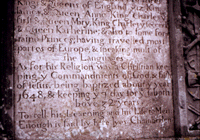 St. Margaret’s Chapel in Essex, England, contains the tombstone of Puritan Sabbath keeper Dr Peter Chamberlen, a respected, trusted, and much-loved physician to three sets of kings and queens in 17th century England.
The inscription on the tombstone reads as follows:
“The said Peter Chamberlen took ye degree of Doctor in Physick, in fever all Universities born at home and abroad and lived such above three score years, being physician in ordinary to three Kings and Queens of England. viz. King James & Queen Anne; King Charles the first & Queen Mary; King Charles the second & Queen Katherine; & also tosome forraine Princes; having travelled most of partes of Europe and speaking most of the languages.
As for his religion, he was a Christian keeping the Commandments of God & faith of Jesus. being baptised about the year 1648, & keeping the 7th day for ye saboth above 32 years. To tell his Learning and his Life to Men: Enough is said by here lies Chamberlen.”
18th Century Sabbath History
“It cannot be shown that Sunday has taken the place of the Sabbath (P.366). The Lord God has sanctified the last day of the week. Antichrist, on the other hand, has appointed the first day of the week.” Ki Auszug aus Tennhardt’s “Schriften,” P.49 (printed 1712)
Abyssinia
“The Jacobites assembled on the Sabbath day, before the Domical day, in the temple, and kept that day, as do also the Abyssinians, as we have seen from the confession of their faith by the Ethiopian king Claudius.” Abundançus, ‘Historia Jacobatarum’, pp.118-9 (18th Century)
Romania, 1760 (and what is today) Yugoslavia, Czechoslovakia
“Joseph II’s edict of tolerance did not apply to the Sabbatarians, some of whom again lost all of their possessions.” Jahrgang 2, 254
“Catholic priests aided by soldiers forcing them to accept Romanism nominally, and compelling the remainder to labour on the Sabbath and to attend church on Sunday,-these were the methods employed for two hundred fifty years to turn the Sabbatarians.
Germany-Tennhardt of Nuremberg
“He holds strictly to the doctrine of the Sabbath, because it is one of the ten commandments.” Bengel’s “Leben und Wirken,” Burk, p.579
He himself says: “It cannot be shown that Sunday has taken the place of the Sabbath (P.366). The Lord God has sanctified the last day of the week. Antichrist, on the other hand, has appointed the first day of the week.” Ki Auszug aus Tennhardt’s “Schriften,” P.49 (printed 1712)
Bohemia and Moravia (today – the Czech Republic)
Their history from 1635 to 1867 is thus described by Adolf Dux: “The condition of the Sabbatarians was dreadful. Their books and writings had to be delivered to the Karlsburg Consistory to become the spoils of flames.” Aus Ungarn, pp. 289-291. Leipzig, 1850
Holland and Germany
“Dr. Cornelius stated of East Friesland, that when Baptists were numerous, “Sunday and holidays were not observed,” (they were Sabbath-keepers). Der Anteil Ostfrieslands und Ref. Muenster,” 1852, pp l29, 34
Moravia-Count Zinzendorf
In 1738, Zinzendorf wrote of his keeping the Sabbath thus: “That I have employed the Sabbath for rest many years already, and our Sunday for the proclamation of the gospel.” Budingsche Sammlung, Sec. 8, p. 224. Leipzig, 1742
America – 1741
-Moravian Brethren (after Zinzendorf arrived from Europe). “As a special instance, it deserves to be noticed that he is resolved with the church at Bethlehem to observe the seventh day as a rest day. Id., pp. 5, 1421, 1422
America
However, before Zinzendorf and the Moravians at Bethlehem initiated the observance of the Sabbath and prospered, a small group of German Sabbath-keepers had already established themselves in Pennsylvania. See Rupp’s “History of Religious Denominations in the United States,” pp.109- 123
19th Century Sabbath History
“But the majority moved to the Crimea and the Caucasus, where they remain true to their doctrine in spite of persecution until this present time. The people call them Subotniki, or Sabbatarians”, Sternberg, “Geschichte der Juden in Polen,” p.124
China
“At this time Hung prohibited the use of opium, and even tobacco, and all intoxicating drinks, and the Sabbath was religiously observed.” The Ti-Ping Revolution,” by Llin-Le, and officer among them, Vol. 1, pp.36-48, 84
“The seventh day is most religiously and strictly observed. The Taiping Sabbath is kept upon our Saturday.” P. 319
“The Taipings, when asked why they observed the seventh-day Sabbath, replied that it was, first, because the Bible taught it, and, second, because their ancestors observed it as a day of worship.” A Critical History of the Sabbath and the Sunday.
India and Persia
“Besides, they maintain the solemn observance of Christian worship throughout our Empire, on the seventh day.” Christian Research in Asia,” p.143
Denmark
“This agitation was not without its effect. Pastor M.A. Sommer began observing the seventh day and wrote in his church paper. “Indovet Kristendom” No.5,1875 an impressive article about the true Sabbath. In a letter to Elder John G.Matteson, he says:
“Among the Baptists here in Denmark, there is a great agitation regarding the Sabbath commandment..However, I am probably the only preacher in Denmark who stands so near to the Adventists and who for many years has proclaimed Christ’s second coming.” Advent Tidente,” May, 1875
Russia
“But the majority moved to the Crimea and the Caucasus, where they remain true to their doctrine in spite of persecution until this present time. The people call them Subotniki, or Sabbatarians,” Sternberg, “Geschichte der Juden in Polen,” p.124
Sweden (Baptists)
“We will now endeavour to show that the sanctification of the Sabbath has its foundation and its origin in a law which God at creation itself established for the whole world, and as a consequence thereof is binding on all men in all ages.” Evangelisten (The Evangelist). Stockholm, May 30 to August 15, 1863 (Swedish Baptist Church)
America – 1845
“Thus we see Dan. 7, 25, fulfilled, the little horn changing ‘times and laws. ‘Therefore, it appears to me that all who keep the first day for the Sabbath are Pope’s Sunday-keepers and God’s Sabbath-breakers.” Elder T.M. Preble, Feb.13, 1845
America (Seventh-day Adventists)
In 1844, Seventh-day Adventists arose and had spread to nearly all the world by the close of the 19th Century. Their name is derived from their teaching of the seventh-day Sabbath and the Advent of Jesus. In 1874, their work was established in Europe, 1885 -Australasia, 1887-South Africa, 1888-Asia, 1888-South America. Seventh-day Adventists uphold the same Sabbath that Jesus and His followers kept. The sacred Torch of Truth was not extinguished through the long centuries. Adventists are working today in nearly 1000 languages of the earth and have over 27,000 churches. Over ten million members around the globe welcome the sacred Sabbath hours.
20th Century Sabbath History
Baptist Convention
“The first four commandments set forth man’s obligations directly toward God…. But when we keep the first four commandments, we are likely to keep the other six. . . . The fourth commandment sets forth God’s claim on man’s time and thought…. The six days of labour and the rest on the Sabbath are to be maintained as a witness to God’s toil and rest in the creation. . . . No one of the ten words is of merely racial significance…. The Sabbath was established originally (long before Moses) in no special connection with the Hebrews, but as an institution for all mankind, in commemoration of God’s rest after the six days of creation. It was designed for all the descendants of Adam.” -Adult Quarterly, Southern Baptist Convention series, Aug. 15, 1937.
Roman Catholic
“It is well to remind the Presbyterians, Baptists, Methodists, and all other Christians, that the Bible does not support them anywhere in their observance of Sunday. Sunday is an institution of the Roman Catholic Church, and those who observe the day observe a commandment of the Catholic Church.” Priest Brady, in an address, reported in the Elizabeth, NJ ‘News’ on March 18, 1903.
“The Church, on the other hand, after changing the day of rest from the Jewish Sabbath, or seventh day of the week, to the first, made the Third Commandment refer to Sunday as the day to be kept holy as the Lord’s Day. The Council of Trent (Sess. VI, can. xix) condemns those who deny that the Ten Commandments are binding on Christians.” The Catholic Encyclopedia, Commandments of God, Volume IV, © 1908 by Robert Appleton Company – Online Edition © 1999 by Kevin Knight, Nihil Obstat – Remy Lafort, Censor Imprimatur – +John M. Farley, Archbishop of New York, page 153.
‘Deny the authority of the Church and you have no adequate or reasonable explanation or justification for the substitution of Sunday for Saturday in the Third – Protestant Fourth – Commandment of God… The Church is above the Bible, and this transference of Sabbath observance is proof of that fact.” Catholic Record, September 1, 1923.
“If Protestants would follow the Bible, they would worship God on the Sabbath Day. In keeping the Sunday, they are following a law of the Catholic Church.” Albert Smith, Chancellor of the Archdiocese of Baltimore, replying for the Cardinal, in a letter dated February 10, 1920.
Episcopal
“The Bible commandment says on the seventh-day thou shalt rest. That is Saturday. Nowhere in the Bible is it laid down that worship should be done on Sunday.” Phillip Carrington, quoted in Toronto Daily Star, Oct 26, 1949 [Carrington (1892-), Anglican archbishop of Quebec, spoke the above in a message on this subject delivered to a packed assembly of clergymen. It was widely reported at the time in the news media.
Lutheran
“We have seen how gradually the impression of the Jewish Sabbath faded from the mind of the Christian church, and how completely the newer thought underlying the observance of the first day took possession of the church. We have seen that the Christians of the first three centuries never confused one with the other, but for a time celebrated both.” The Sunday Problem, a study book by the Lutheran Church (1923), p.36
Church of Christ
“But we do not find any direct command from God, or instruction from the risen Christ, or admonition from the early apostles, that the first day is to be substituted for the seventh day Sabbath.” “Let us be clear on this point. Though to the Christian, that day, the first day of the week, is the most memorable of all days … there is no command or warrant in the New Testament for observing it as a holy day.” “The Roman Church selected the first day of the week in honour of the resurrection of Christ. …” Bible Standard, May, 1916, Auckland, New Zealand.
Church of England
“Nowhere in the Bible is it laid down that worship should be done on Sunday. Remember the Sabbath day to keep it holy. …! That is Saturday.” P. Carrington, Archbishop of Quebec, Oct. 27, 1949.
Smithsonian Institute
“The evaluation of Sunday, the traditionally accepted day of the resurrection of Christ, has varied greatly throughout the centuries of the Christian Era. From time to time, it has been confused with the seventh day of the week, the Sabbath. English speaking peoples have been the most consistent in perpetuating the erroneous assumption that the obligation of the fourth commandment has passed over to Sunday. In popular speech, Sunday is frequently, but erroneously, spoken of as the Sabbath.” -F. M. SETZLER, Head Curator, Department of Anthropology, Smithsonian Institute, from a letter dated Sept. 1, 1949.